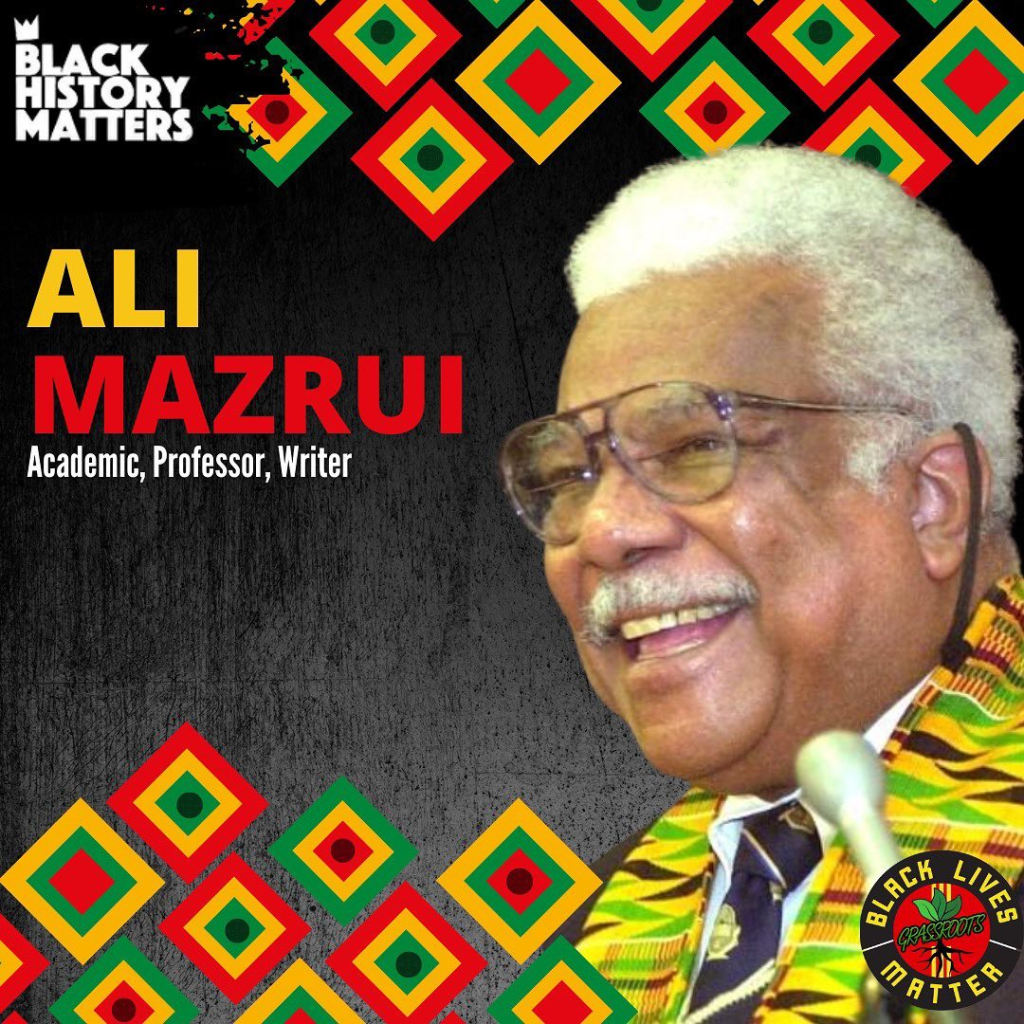
Ali Mazrui – Academic, Professor, Writer

African intellectuals who served as leaders of anti-colonial movements have largely been recognized for their contributions to the African revolution. The same cannot be said about their counterparts who did not venture out of academia, even though the role of their scholarship in shaping African nationalism and its postcolonial manifestations is inexorably instructive. Ali Al’amin Mazrui stands among the finest African intellectuals who theorized about African nationalism and its possibilities and challenges.

Born on Feb. 24, 1933, in Kenya, Mazrui received his education in Kenya, England, and the U.S. Upon completing his studies abroad, he returned to Africa and taught at Makerere University in Uganda (1967-1973). Thereafter, Mazrui relocated to the U.S. and joined the faculty of the University of Michigan as Professor and later as Director of the Center for Afro-American and African Studies (1974-1991).

Beyond his tenure at the University of Michigan, Mazrui served as Professor and Director of the Institute of Global Cultural Studies at SUNY Binghamton (1991-2014). He held professorships in various countries in Africa, Asia, the Caribbean, and several American universities. Mazrui wrote extensively on imperialism, colonialism, reparations, nationalism, religion, race, terrorism, and nuclear proliferation. A strident critic of the orthodoxies of African intellectualism, Mazrui also exerted his intellect on global apartheid and its exploitation of Africa and the African Diaspora. Not surprisingly, his peers celebrated him for “arm[ing] us with the tools of engagement and inspire[ing] us with his eloquence [and] clarity of thought” (Salim: 2016). Mazrui spent his life in academia and never adjusted his scholarship to placate the global capitalist system that finances almost all the universities where he taught and/or held various professorships. Thus, when he joined his ancestors on Oct. 12, 2014, Mazrui left an instructive legacy of speaking and writing truth to power and using the ivory tower to advance the cause of global African liberation.

Ali Mazrui – Academic, Professor, Writer

African intellectuals who served as leaders of anti-colonial movements have largely been recognized for their contributions to the African revolution. The same cannot be said about their counterparts who did not venture out of academia, even though the role of their scholarship in shaping African nationalism and its postcolonial manifestations is inexorably instructive. Ali Al’amin Mazrui stands among the finest African intellectuals who theorized about African nationalism and its possibilities and challenges.

Born on Feb. 24, 1933, in Kenya, Mazrui received his education in Kenya, England, and the U.S. Upon completing his studies abroad, he returned to Africa and taught at Makerere University in Uganda (1967-1973). Thereafter, Mazrui relocated to the U.S. and joined the faculty of the University of Michigan as Professor and later as Director of the Center for Afro-American and African Studies (1974-1991).

Beyond his tenure at the University of Michigan, Mazrui served as Professor and Director of the Institute of Global Cultural Studies at SUNY Binghamton (1991-2014). He held professorships in various countries in Africa, Asia, the Caribbean, and several American universities. Mazrui wrote extensively on imperialism, colonialism, reparations, nationalism, religion, race, terrorism, and nuclear proliferation. A strident critic of the orthodoxies of African intellectualism, Mazrui also exerted his intellect on global apartheid and its exploitation of Africa and the African Diaspora. Not surprisingly, his peers celebrated him for “arm[ing] us with the tools of engagement and inspire[ing] us with his eloquence [and] clarity of thought” (Salim: 2016). Mazrui spent his life in academia and never adjusted his scholarship to placate the global capitalist system that finances almost all the universities where he taught and/or held various professorships. Thus, when he joined his ancestors on Oct. 12, 2014, Mazrui left an instructive legacy of speaking and writing truth to power and using the ivory tower to advance the cause of global African liberation.

Recent Posts

Black Lives Matter Grassroots Stands with Twin Cities

We are grateful for the courage, vision, sacrifice, and power of Black Lives Matter Grassroots Twin Cities lead Chauntyll Allen, courageous comrade Nekima Levy Armstrong, and other principled organizers for their righteous resistance to the Immigration and Customs Enforcement (ICE) federal invasion and fascist repression in Minneapolis/St. Paul. Rather than submitting to an unparalleled evil that murders mothers in their own vehicles, explodes chemical weapons upon infants, kidnaps and imprisons preschoolers, brutalizes children, separates families, and terrorizes communities, grassroots organizers in the Twin Cities are putting their own bodies, freedom and livelihood on the line to secure community.

Read More »

Sign up for our Newsletter

Black Lives Matter Grassroots

All Rights Reserved © 2022

Recent Posts

Black Lives Matter Grassroots Stands with Twin Cities

We are grateful for the courage, vision, sacrifice, and power of Black Lives Matter Grassroots Twin Cities lead Chauntyll Allen, courageous comrade Nekima Levy Armstrong, and other principled organizers for their righteous resistance to the Immigration and Customs Enforcement (ICE) federal invasion and fascist repression in Minneapolis/St. Paul. Rather than submitting to an unparalleled evil that murders mothers in their own vehicles, explodes chemical weapons upon infants, kidnaps and imprisons preschoolers, brutalizes children, separates families, and terrorizes communities, grassroots organizers in the Twin Cities are putting their own bodies, freedom and livelihood on the line to secure community.

Read More »

Sign up for our Newsletter

Black Lives Matter Grassroots

All Rights Reserved © 2022